Knapped, Fired and Limewashed: Reading Chenies Through Its Walls

Photo by Photo by Pawel Czerwinski on Unsplash on Unsplash
We are trained, as visitors, to look at the big things. The manor, the church tower, the war memorial, the pub sign. All excellent, all worth your time. But there is a second Chenies running alongside the photogenic one, and it is made almost entirely of surfaces. Walls, boundaries, garden edges, the sides of sheds. Look at them properly and the village starts explaining itself — not through plaques and interpretation boards, but through the raw materials someone carted here, stacked up and pointed, several centuries ago.
This is a short field guide to those surfaces, plus a walk of roughly a mile that takes them in. No special knowledge required. A mild interest in texture helps.
Why Chenies looks the way it does
The Chilterns are not generous with good building stone. There is chalk, there is clay, and there is a great deal of flint knocking about in the fields. That single geological fact explains most of what you will see. Where other parts of the country had lovely freestone to carve, this corner of Buckinghamshire had to make do, improvise, and — in the case of the wealthier households — import. The result is a village where the walls are a record of budget as much as taste.
Flint: the honest local option
Start with flint, because flint is everywhere. Look for the small, knobbly, grey-brown stones set into mortar, often in a cottage wall or a boundary running along a lane. The best examples are knapped — split open so the dark glassy face shows, giving a wall a slightly glittery, speckled look that photographs badly and looks wonderful in low winter light.
Flint is cheap, local and extremely hard-wearing, which is why it turns up in field walls, churchyards and outbuildings. It is also awkward to work with, because the stones do not come in convenient rectangles. Medieval and later builders got round this by using lots of mortar and by framing flint panels with brick quoins at the corners — a chequerboard of grey and red that is one of the most characteristic sights in this part of the world. If you see flint framed neatly in brick, you are looking at a sensible compromise between what was underfoot and what was in the yard.
Brick: the arriviste
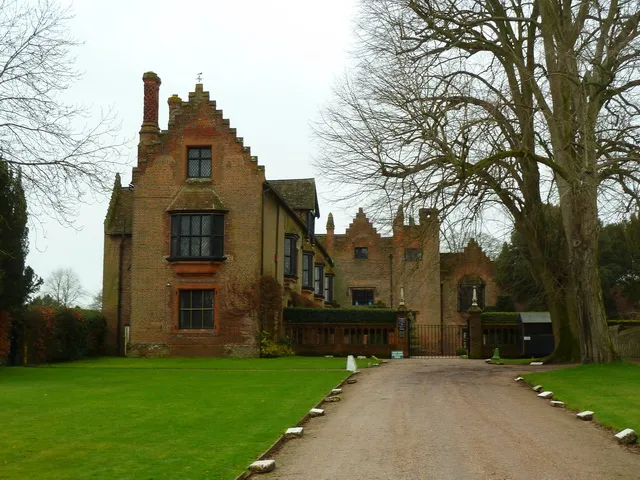
Red brick arrives with money. Tudor brickwork — and Chenies has no shortage of Tudor associations — is a statement material: regular, fired, transported, and considerably more expensive than a pile of field stones. Look for brick laid in tidy courses, sometimes with diapering (diamond patterns in a contrasting colour), and for those tall, twisted chimneys that are practically a signature of the period.
Later centuries used brick more casually. Georgian and Victorian additions tend to be plainer, and you can often spot where an older flint wall has been patched or extended in brick — a seam of red running through grey, like a repair to a favourite jumper. These joins are not flaws. They are the village's edit history, visible in daylight.
Render and limewash: the great disguiser
Then there is render. Smooth, creamy, sometimes faintly pink, occasionally a bold colour that would have raised an eyebrow in 1800. Render was the practical answer to a rough or porous wall: slap it on, paint it, and the building is weatherproof and respectable. Limewash in particular has a soft, chalky finish that suits the valley beautifully.
Be a little wary of assuming age from colour alone. A rendered cottage may be seventeenth-century underneath or may be a twentieth-century rebuild with good manners. The giveaway is usually at the base — look for the plinth, the way the render stops short of the ground, and whether the wall bulges where the timber frame behind it has settled. Old walls are rarely straight, and that is half their charm.
Weatherboard: the practical black
Finally, weatherboard. Painted timber cladding, usually black or very dark, turns up on barns, sheds and the odd village building. It is cheap, quick to replace, and brilliantly effective at shedding rain on a west-facing wall. It is also the material most likely to be dismissed as unremarkable. Do not dismiss it. A black weatherboarded outbuilding against a flint wall and a wet November sky is about as Buckinghamshire as it gets.
What boundaries tell you
A wall is not just a wall; it is a line drawn between one household and the next. In Chenies, as in most old villages, the height of a boundary is a fairly reliable index of status. Tall brick walls with coping stones guard the manor and its immediate neighbours. Low flint or brick walls, or simple hedges, mark the cottages nearer the green, where the boundary is more about keeping chickens in than keeping people out.
Look for the small details while you are at it: blocked-up gateways, changes in coping, walls that step down a slope in stages rather than following it smoothly. Each one is a small decision made by somebody who is long gone.
A one-mile route for wall-watchers
This is not a strenuous walk. It is barely a walk at all, which is the point.
- Begin at the village green. Stand back and look at the mix of materials around you. Brick, render, flint — three households, three budgets, three centuries, all within a few paces.
- Head towards the church. The churchyard boundary is a fine place to study flint and mortar up close. Notice how the wall's coping changes as it goes; this is a boundary that has been repaired by many different hands.
- Follow the lane past the manor walls. Here the brickwork is smarter, the coping heavier, the message clearer. You are walking alongside a private estate, so admire from the path and keep your hands to yourself.
- Drop down towards the Chess. Look for damp-loving render, patched brick and the occasional weatherboarded shed. Water and walls have a long and complicated relationship down here.
- Return along a different lane. Same materials, different combinations. By now you will be noticing things you would have walked straight past an hour earlier.
A few courtesies
Everything described here is visible from public ground. Garden walls belong to the people behind them, so no leaning over, no peering through gaps and no testing the mortar with a fingernail. Most of what you want to see is right there at eye level anyway.
And that is the quiet pleasure of it. You do not need a ticket, a guidebook or a decent forecast. Just a village, a bit of time, and the willingness to look sideways instead of straight ahead. The manor is magnificent, but the walls have been here longer and they gossip more.