A Green, a List and a Village Remembers: Chenies War Memorial in 2026
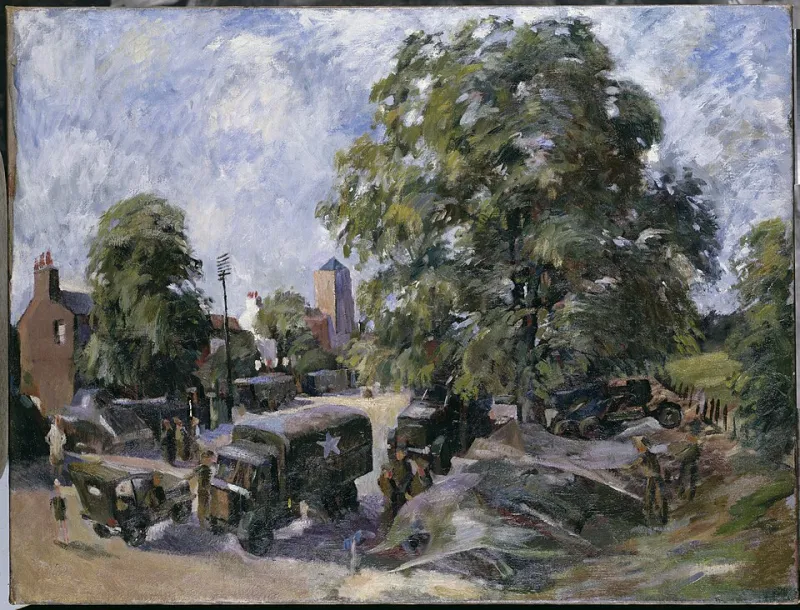
Photo: Mozley, Charles, Public domain, via Wikimedia Commons
Today is Remembrance Sunday, 8 November 2026, and the green at Chenies will do what it has done for generations: hold a small crowd, a silence, and a list. The war memorial is easy to pass on an ordinary walk. It is a familiar shape at the edge of the village, and familiarity can make us lazy. Remembrance asks us to stop and read.
The stone and the green
Village war memorials are not usually grand. They are often crosses, obelisks or simple panels set where the parish can gather without blocking the road. Chenies' memorial belongs to that tradition: a local marker in a local place, close to the green, close to the church, close to the lanes that lead out into the fields. It does not need a visitor centre. It needs a few minutes of attention.
The first thing to notice is the setting. This is not a museum object behind glass. It is part of the village's everyday geography. People walk past it with shopping, dogs, pushchairs and the ordinary business of a Tuesday morning. That is as it should be. A war memorial is not separate from village life; it is one of the things that gives village life its shape.
How to read a village memorial
Start with the structure. Many parish memorials list the dead of the First World War in one panel and the Second World War in another. You will often see rank, name, regiment or service, and sometimes an age or a date. The order may follow service branch, alphabet, or the arbitrary logic of a committee trying to do the right thing in difficult circumstances.
Then read the names as a map of the village. In a place like Chenies, the list is not an abstract roll of honour. It points back to farms, cottages, estates, trades and families. Some surnames will repeat. That repetition is one of the quietest and most devastating things about a village memorial: brothers, cousins, neighbours, men from the same short lane. A national story becomes a local ledger.
Look for the gaps too. Not everyone who died is necessarily named on a parish memorial. Some families moved away. Some deaths happened far from the village and were commemorated elsewhere. Some people who served and returned are not listed at all, because the memorial was built for the dead, not for the survivors. The list is a beginning, not the whole story.
The families behind the names
It is tempting to treat the names as a single block of history, but each one opens a different door. A farm labourer, a railway worker, a shopkeeper's son, a young officer from a local house: the memorial gathers them into one stone, but their lives would have been very different. The point of reading is not to flatten those differences. It is to notice them.
Local archives can help. Parish records, census returns, newspaper notices and the Commonwealth War Graves Commission database can all add detail to a name. Sometimes you will find an address that is still standing. Sometimes you will find a photograph. Sometimes you will find nothing more than a date and a regiment, and you have to let the silence do the rest.
This is not detective work for its own sake. It is a way of turning a name into a person, and a person into a neighbour across time. You do not need to be a historian to do it. You only need to be curious and patient.
A short remembrance walk
Begin at the memorial itself. Stand for a moment without taking a photograph. Read one name. Say it quietly if you like. Then walk the short way to the church, not to inspect the churchyard stones, but to register the relationship between the memorial and the building that has held the village's services, baptisms, marriages and funerals for centuries. The two belong together.
From there, take a small loop around the green and along the lane. Notice the roofs, the walls, the gates and the trees. This is the village the names belonged to. You are not walking through a battlefield; you are walking through the place the men left and the place that remembered them. That contrast is the point.
Finish back at the memorial. If there are poppies, look at how they have been placed. If there are wreaths, read the cards. If there is nothing but stone, that is enough. The walk should take twenty minutes, not a whole afternoon. Remembrance is better when it is simple.
How Chenies marks remembrance today
In 2026, the pattern will be familiar to most villages: a gathering at the memorial, a short act of remembrance, the two-minute silence at 11am, wreaths and poppies, and the ordinary life of the village continuing afterwards. The details may be modest. A reading, a prayer, a bugler if one is available, a few words from someone who has done it before. The scale is not the point.
What matters is that the village turns up. Remembrance is one of the few civic rituals that still asks people to stand still together without needing to be entertained. It is not a performance. It is a pause.
For visitors, the best way to take part is quietly. Arrive early, stand at the edge, follow the lead of those who know the format, and stay for the silence. If you are not sure what to do, do less. That is usually the right instinct.
Reading on from the silence
After the ceremony, the memorial becomes a starting point again. You can look up a name. You can ask a local question. You can walk the lanes and imagine the village as it was between the wars. You can bring a child and explain why the stone has names on it. None of this needs to be grand.
The memorial by the green is not there to make us feel good about remembering. It is there to make us stop. In 2026, in a village of lanes, hedges and quiet corners, that is still a radical thing: a list of names that asks for nothing but attention.