Pull In, Say Thanks: How Chenies Shares Its Lanes
Photo: Vitagraph Company of America, Public domain, via Wikimedia Commons
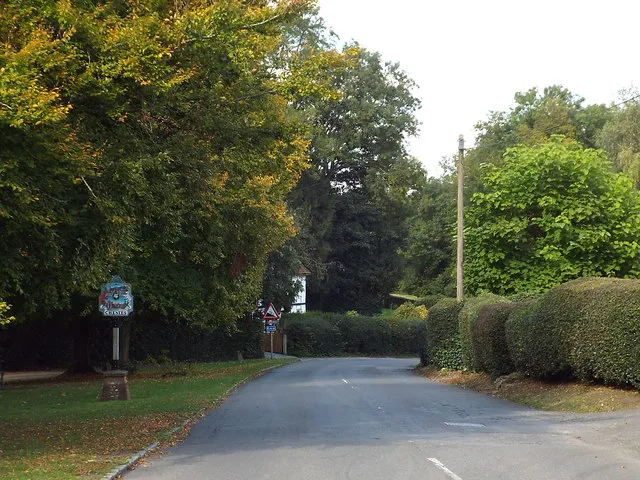
Here is a thing visitors notice within about ninety seconds of turning off the main road: the lanes around Chenies are not wide enough for two cars and a conversation. They are wide enough for two cars if both parties are paying attention and one of them is willing to be gracious. That is not a design flaw. It is the arrangement, and it has been the arrangement for a very long time.
So, with winter hedging done and the lanes narrower than they were in June, a short guide to sharing them.
Rule one: reverse before you have to
Passing places are not laybys. They are the reason a single-track lane works, and the whole system collapses if people treat them as parking. If you can see an oncoming vehicle and you are nearer a gap than they are, take the gap now. Waiting until you are nose to nose, with a hedge on one side and a verge on the other, means somebody has to reverse — and the person who has driven fifty yards up a lane is far worse placed to do it than you are.
Reversing lights are a language. When you see them, stop, leave room, and wait. Do not creep forward to "help". Do not sit so close that the other driver is reversing blind.
Rule two: the wave is cheap and it works
Two fingers off the wheel. A nod. A raised hand through the windscreen. The courtesy wave is the single most efficient piece of social infrastructure in Buckinghamshire, and the fact that it costs nothing does not make it worthless. Somebody has just reversed sixty yards into a gateway for you, in the rain, in the dark. Acknowledge it.
The reverse is also true. If you are the one who should have reversed and did not, or you took a gap a little too optimistically, a raised hand of apology defuses in a second what a stony stare extends for a mile.
Rule three: walkers, horses, and giving room
There is a hierarchy on a country lane and it is not about who pays the most road tax. It goes roughly: horses, then people on foot with dogs and children, then cyclists, then cars. A horse is a half-tonne animal with the survival instincts of a prey species, and a car revving behind it is a genuine hazard. Slow to walking pace. Pass wide. Give a rider a chance to acknowledge you before you come past.
Walkers on these lanes often have no pavement at all, and in November the verges are either sodden or ankle-deep in leaves. A little space, a little patience at a blind bend, and the whole interaction takes four seconds rather than spoiling somebody's afternoon.
Rule four: the working vehicles get priority
Tractors, feed deliveries, vans, the bin lorry, the occasional horsebox — the lanes around Chenies exist to serve the working life of the place, not just the scenic drive. If a large vehicle is committed to a narrow stretch, let it finish. Reversing a tractor out of a gateway is not a quick manoeuvre, and there is usually a reason it cannot simply tuck in.
It is also worth remembering the practical timetable. School-run hours, delivery windows and bin day all put more metal into the same few hundred yards of lane than the lanes were designed for. If your journey can happen at ten in the morning rather than eight-forty, it will be calmer and quicker.
Rule five: where not to leave the car
A short list, delivered without apology.
- Not in a passing place, ever.
- Not on a verge, which turns to mud and then stays mud until April.
- Not across a footpath entrance, a bridleway, a field gateway or the churchyard gate.
- Not so close to a bend that another driver meets you with nowhere to go.
- Not blocking the access that somebody else needs at seven in the morning.
Chenies is a village that people visit, and that is broadly a good thing. Visitors who park considerately are indistinguishable from residents who do.
Rule six: dark evenings and dipped headlights
The lane has no street lighting to speak of, which is one of its virtues and one of its hazards. Dip early rather than late — a main beam in a driver's mirror on a frosty single-track lane is not a friendly gesture. If you walk these lanes after dark, something reflective is not vanity, it is arithmetic: you are competing with a hedge for the driver's attention and losing.
When it goes wrong
It will, occasionally. Somebody will misjudge a gap, or assume a lane is empty, or be in a hurry on a morning when nobody should be. The useful assumption is competence rather than malice: that the other driver simply did not see you, or is from out of the area, or has a screaming child in the back. A shrug and a wave gets you both moving. A standoff gets you both parked.
The unwritten code, in short
Pull in early. Reverse willingly. Wave anyway. Give horses and walkers the width they need. Leave the passing places clear. Dip the lights. And treat the lane as something shared rather than something owned.
It is a modest code, and it has less to do with driving skill than with temperament. Which is, in the end, the sort of village Chenies is: a place where getting along is a practical arrangement, agreed fresh every time two cars meet between hedges.