Nettles, Hinges and Yellow Arrows: The Quiet Work Behind Chenies' Footpaths
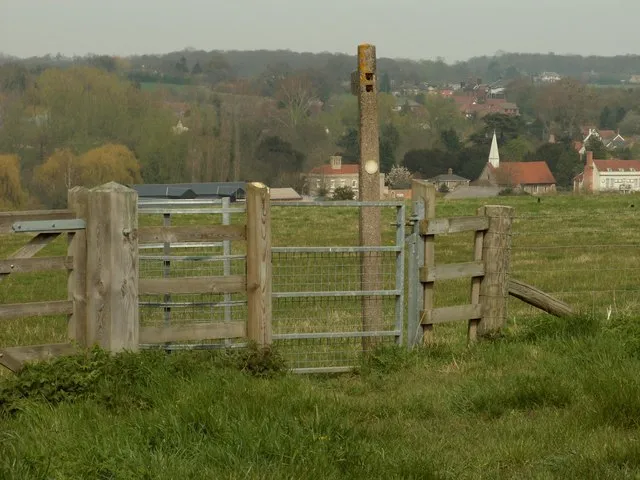
Photo: Robert Edwards, CC BY-SA 2.0, via Wikimedia Commons
On a grey November morning, the footpaths around Chenies are doing what they always do: quietly getting on with it. The Chess is running high, the field gates are muddy at the latch, and the yellow waymark discs stand out against hedges that have been cut back since summer. It is tempting to think this is just how paths are. They are not. Somebody has been out with loppers, somebody has tightened a hinge, and somebody has decided that this particular nettle patch has finally had its day.
This is a walk with a maintenance eye. Not a survey, not an inspection, just a short loop from the village green with a bit of attention paid to the things that make a path usable. The route is roughly three miles, down towards the Chess and back up through the lanes, and it works in boots or sturdy shoes. Take the OS map or the council's online path map, because the point is not to follow a prescribed trail but to notice what keeps the network open.
A loop with a maintenance eye
Start on the green and head downhill towards the valley. The first thing you meet is usually a squeeze or a kissing gate, and the first thing to notice is whether it swings freely. A gate that catches, drops on its hinge or needs a shoulder to shift is not a disaster, but it is a clue. These are the small failures that turn a quick walk into a muddy scramble, especially when you are carrying a flask and a dog lead in one hand.
Drop down towards the Chess and follow the waymarks where the path meets the water. In autumn the vegetation has died back enough to see the line of the path clearly, but the ground can be slick. Look for the places where someone has put down gravel, cut a step into a bank or trimmed a tunnel through the hedge. These are the unglamorous fixes that make a right of way feel cared for. On the climb back up, the path crosses fields and passes through gates that mark the boundary between one landowner and the next. Each one is a little contract between walker and farmer, and each one needs looking after.
Who actually does what
The plain-English version is that no single person owns the job. Buckinghamshire Council is the highway authority for public rights of way, which means it has a legal role in recording and protecting the network. Chenies Parish Council is the local voice, the one that hears about the gate that will not shut and the path that disappears under a crop. Landowners have responsibilities on the ground, and volunteers fill in plenty of gaps with secateurs, waymark discs and quiet persistence.
That last part matters. The Chilterns is full of people who walk the same paths week after week and notice when something changes. Some are official parish path volunteers; others are simply regulars who report a problem rather than stepping over it. The Chiltern Society and similar groups run practical work parties in the wider landscape, and parish councils often keep an eye on the paths closest to home. It is a patchwork, not a single crew in a van.
The legal framework sits underneath all this. The definitive map records which paths are public rights of way and what type they are. A footpath is for walking; a bridleway is for walkers, horse riders and cyclists; a byway is open to vehicles. Most of what you walk around Chenies is footpath, often following old field boundaries and routes that predate the idea of a weekend stroll. The map is the reference point when there is a dispute, but the daily reality is maintenance: cutting, marking, lifting, replacing and reporting.
The landowner bit, without the jargon
Landowners are not expected to turn paths into parkland. They are expected to keep the route usable. That means not blocking a path with a fence, hedge or parked machinery, keeping crops from swamping the line of the way, and making sure gates and stiles are in working order. In practice, farming is a business with weather, seasons and animals in the mix. A hedge that looks scruffy in February may be full of nesting birds by April. A muddy gateway in November is not automatically neglect; it is what happens when cattle, rain and walkers share the same few metres.
Walkers have a part too. Stay on the line of the path, close gates behind you, keep dogs under control around livestock and do not assume that a shortcut through a crop is harmless. If a gate is tied shut with baler twine, that is worth reporting, but it is rarely a reason to climb over a fence. The quiet contract works best when both sides remember that the other is trying to get something done.
How to report a problem without sounding like a jobsworth
If you find a broken stile, a jammed gate, a missing waymark or a bridge that feels unsafe, report it. The trick is to be useful rather than indignant. Note where you were, what the problem is and what it stops you doing. A grid reference is ideal; a photograph is even better. If there is a path number on the map or a waymark, include it. Say whether the issue is urgent, such as a damaged bridge or a live electric fence across the path, or simply annoying, such as a nettle patch closing in on a gate.
Buckinghamshire Council has an online route for reporting public rights of way problems, and the parish council is a good second port of call for local paths. Keep the message short and factual. 'The kissing gate at the bottom of the field is off its hinge and will not open' is more useful than a paragraph about the state of the countryside. Avoid confronting a landowner mid-job; report it and let the proper people have the conversation. And if a volunteer has clearly been out with a strimmer, say thank you when you see them. It is a small thing, but path maintenance runs on goodwill as much as on paperwork.
What a cared-for path looks like
By the time the loop brings you back up to the village, the clues are easy to read. A fresh yellow arrow, a hinge with a drop of oil on it, a step cut into a muddy bank, a gate that closes with a satisfying clunk. None of it is dramatic. That is the point. The footpath network around Chenies is not maintained by grand gestures but by a series of small, ordinary decisions made by people who would rather walk a clear path than talk about one.
So next time you take the short loop down to the Chess, look at the gate before you go through it. If it swings, thank the hinge. If it does not, make a note. The paths belong to all of us, but the work of keeping them open belongs to a scattered and mostly unsung group of people who do it anyway. A walk with a maintenance eye is still a walk. It just notices the nettles, the hinges and the yellow arrows a little more.