Hinges, Piers and Worn Stone: Five Doorways Into Chenies
Photo: Joe Mabel, Public domain, via Wikimedia Commons
Monuments ask to be admired. Thresholds ask to be used. Chenies is well supplied with the first and quietly extraordinary in the second: a village whose history can be read less in its plaques than in its hinges, its gate piers, and the small scooped hollows worn into stone by a few centuries of feet.
What follows is not a definitive survey. It is a walk with a theme, and the theme is simple: look at where you are allowed to go, and how the village tells you.
One: the manor gate — iron, patience and a private line
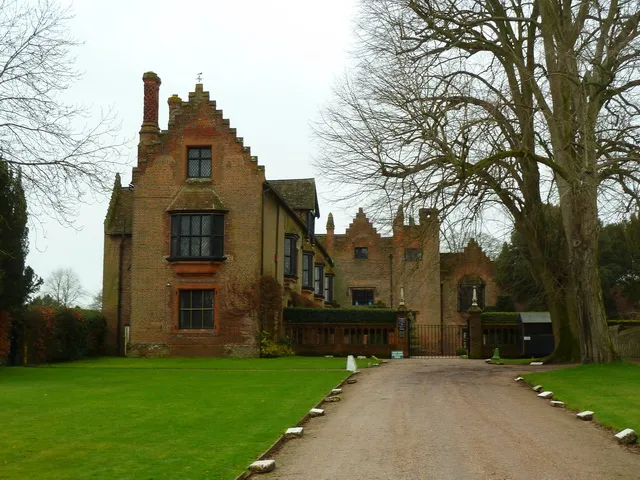
The approach to the manor is the most formal threshold in Chenies, and every part of it is doing work. The piers, the railings, the lodge, the long straight drive: together they say that this is a boundary with a history, maintained by an estate that has been answering the same question for four hundred years — how do you keep a working private place open enough to be part of a village?
The answer, historically, has been gates. Ironwork is a statement of ownership that is also, conveniently, a way of being closed. Notice the joinery rather than the grandeur: hinges sized for a span rather than for ornament, a latch placed at the height a hand expects, gravel swept in a way that shows where vehicles actually turn. The modern arrangement — set visiting times, an opening season, a clear line between the drive and the field paths that cross the estate — is the latest version of an old negotiation between welcome and privacy.
Standing there, the interesting question is not who built the house. It is who has passed through, and with what permission, and how the village learned to read the difference.
Two: the churchyard gate — a roof for the waiting
At St Michael's, the threshold is more hospitable and more solemn at once. A lychgate is a piece of practical theology: a covered place where a coffin could rest, and where mourners could gather out of the weather, before the final few yards to the door. Read the timbers and you can see the habits of the place — the bench worn smooth at one end, the slot where the gate has dropped on its hinges, the stone step dished in the middle by the sort of wear that takes generations.
Churchyard gates are also one of the few thresholds in England that are almost always open. That openness is the point. Whatever the estate gates are doing, this one has been saying something else since the parish began: come in, stand still, look around.
If you walk the churchyard, watch where the grass is thinnest. Paths worn by people who no longer use the main entrance tell you where the village actually walked in 1850, and often still does.
Three: the field gate — baler twine and the language of closing
A five-bar gate at a field edge is the most honest piece of furniture in the parish. It has one job and it announces it: this is stock, this is not stock, and the difference is a latch.
The vocabulary of the field gate is worth learning if you walk here often. A gate tied with baler twine is not broken; it is a message, and the knot is a temporary decision made by someone who knew this morning what the field needed. A gate hung slightly high, dragging at the far end, has been doing its job since before your car was built. A stock net fixed to the lower bars tells you about lambs, and about a farmer who has watched a dog go through a gap before.
The rule is dull and absolute: leave every gate as you found it — open if open, closed if closed — and never decide you know better. Ownership in a farming parish is not a philosophical question. It is a matter of what is behind the gate and who is responsible for it at four in the afternoon.
Four: the footpath gate — the furniture of public access
Chenies' footpaths are furnished with thresholds of a specifically bureaucratic kind, and they are more revealing than they look. A stile is a piece of history: it says that this path was established when walkers could be expected to climb, and that the landowner's priority was keeping stock in. A kissing gate says something else — that a path crosses ground where a pushchair, a dog or a less mobile walker is a normal expectation, and that the parish, or a grant, or a memorial, paid for the difference.
Look for the small inscriptions. Footpath gates in English parishes are frequently someone's memorial, and the lettering on a latch plate can tell you more about a village's affections than any civic plaque. Then look at the wear: the polished centre of a latch, the mud line at the bottom of the posts, the compacted ground in front of a gate that is used far more than the gate beside it.
A word of practical advice here, and it is not historical. Gates on waymarked paths are usually the safest place to cross a field boundary, and they are also where the ground is most churned. In winter, take them slowly.
Five: the garden gate — latch, paint and a name
Finally, the smallest and most social threshold: a cottage gate onto a lane. Picket, low, painted and repainted until the latch is a smooth brass lozenge. There is usually a name on it, or a number, or a piece of ironwork that has survived three changes of ownership.
Garden gates are where a village's etiquette lives. A gate left on the latch, or with a stone against it, is different from a gate shut and bolted, and every resident knows the difference. The height of the gate is a kind of statement too — a low gate invites a conversation over the top, a tall one does not. Notice, on a walk, how many of the older gates open inward rather than outward, and what that says about the priority of the lane.
Walking the five
You can do this in an hour and a half, and you should do it slowly. Begin on the green, where the lanes converge, take in the churchyard gate and the manor approach, walk out to the field edges and the footpath furniture, and finish with the cottage gates along the way back. Look at what has been worn, what has been mended, and what has been left alone.
A monument tells you what a place wanted to be remembered for. A gate tells you what it did on a Tuesday. Chenies, being a village rather than a set piece, has always had more of the second than the first.