Pinned, Pencilled, Posted: A Visitor's Guide to Reading Chenies Between the Lines
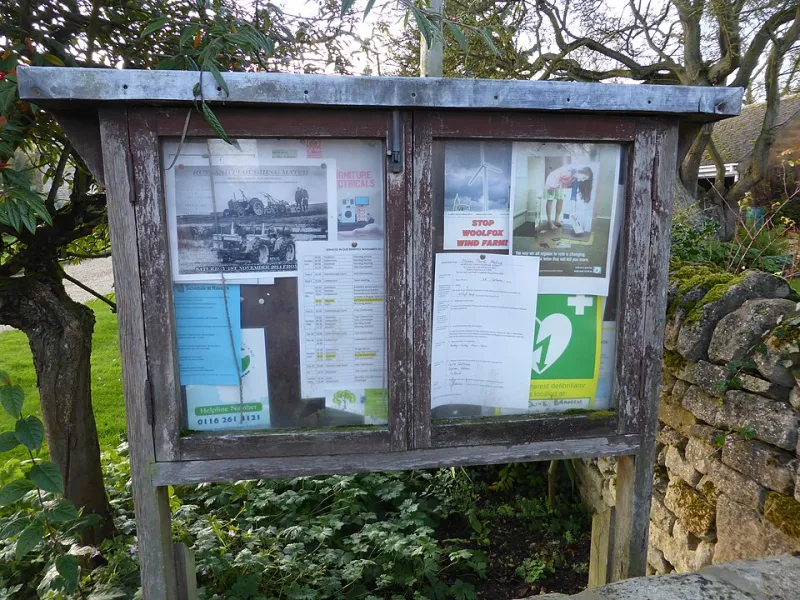
Photo: Bob Harvey , CC BY-SA 2.0, via Wikimedia Commons
There is a particular kind of Buckinghamshire communication that never appears on a screen. It is A5, slightly curled at one corner, and held to a corkboard by a drawing pin that has seen better days. In Chenies, the village noticeboard is not a quaint afterthought. It is the field guide to how the place works — if you know where to look and how to read it.
Three posts, three moods
The church porch at St Michael's is the village's oldest newsfeed. It is where service times sit alongside a poster for a charity coffee morning and a handwritten card offering a lift to anyone who needs one on a Sunday. The porch is sheltered, so the paper survives longer here; notices sometimes fade from cream to the colour of weak tea before anyone takes them down. Look for the layered corners: a new poster pinned over an old one is a small sign of a village that adds rather than replaces.
The village hall noticeboard has a different energy. This is the administrative heart: badminton club, Pilates, the parish council agenda, a reminder about the bonfire society's next meeting. It is busier, more clipped, more likely to use bullet points. If the church porch tells you what Chenies believes in, the village hall tells you what it does on a Tuesday evening in November.
The shop window is the most immediate of the three. It is where lost-and-found cards appear — a set of keys, a dog lead, a single glove — and where small favours are asked and answered. A card reading 'Found: reading glasses near the Chess path' will often have a second line added in biro a few days later: 'Reunited. Thank you.' That tiny amendment is the village's version of a social media update, and it is far more satisfying.
Reading between the lines
A noticeboard is not just a list of events. It is a map of what matters this week. When the same poster appears in all three places, you can be fairly sure it is the main thing happening: the summer fete, the Christmas market, the village quiz. When a notice only appears in the porch, it is probably church business. When it only appears in the shop, it is probably practical — a road closure, a missing cat, a request for a plumber.
Service times are worth a slow read. They tell you when the village is likely to be quiet and when the lanes will have a few more cars in them. A handwritten note about a change to the pattern — 'No 8am service this Sunday' — is a reminder that this is a living calendar, not a printed brochure.
Lost-and-found cards are the closest thing Chenies has to a local newspaper's letters page. They are brief, polite and occasionally funny. 'Found: one small child's welly, blue, near the bridge. Has been placed on the wall by the ford.' You do not need to know the child to enjoy the fact that someone took the trouble.
What is public, what is for residents
Here is the bit that matters if you are visiting. Noticeboards in the porch, the hall and the shop window are public-facing by design. You are welcome to read them. That is what they are for. But a noticeboard is also a conversation between neighbours, and it is worth remembering the difference between reading and joining in.
Take photographs if you like, but avoid close-ups of anything with a name, a phone number or a handwritten address. Do not rearrange the pins. Do not take a poster away because you fancy the design. If a card says 'collection at the village hall, 6pm', it is an instruction for people who already know the context, not an open invitation to turn up and ask questions.
The practical rule is simple: read, smile, move on. If you want to know more about an event, look for the contact details the organiser has chosen to include. If there are none, that is usually a sign the notice is for residents rather than visitors.
A slow tour for a wet Saturday
Start at the church porch, where the light is soft and the paper smells faintly of damp stone. Give yourself five minutes. Read the service times, then the oldest poster you can find. Walk down to the village hall and compare the tone — it will be brisker, more functional. Finish at the shop window, where the lost-and-found cards are usually the best reading in the village.
Do this in November and you will see Chenies at its most honest: dark by half past four, a few leaves stuck to the noticeboard glass, and a handwritten card asking whether anyone has seen a tortoiseshell cat. It is not a tourist attraction. It is better than that. It is the village talking to itself, and you are welcome to listen.
Just remember to put the pin back where you found it.