Frost on the Footpath: A Winter Loop Through Chenies and the Chess Valley

Photo: frosty footpath Chenies Chess Valley Buckinghamshire winter walk, via u.realgeeks.media
Winter has a way of making Chenies feel smaller and more secret. The village green is bare, the church tower stands sharp against a pale sky, and the lane down to the Chess Valley seems to belong to whoever is mad enough to walk it in boots. That is the appeal. This five-mile loop is not a challenge walk or a tick-box trail. It is a quiet corner circuit for the weeks when the calendar is crowded and the countryside is not.
In 2026, the run-up to Christmas will once again send plenty of people towards garden centres, winter fairs and the big heritage sites. Good luck to them. The Chess Valley on a frosty weekday morning offers something different: a chalk stream running clear, hedges stripped back to their bones, and a chance to hear your own boots on the ground. If you want a festive escape without the festive crush, this is it.
Why winter suits this corner
The Chess Valley Walk is a favourite in summer, when the riverside path carries families, dogs and picnics. In January and February it can feel like another place. The views open up when the leaves are down, the river is often at its clearest, and the low sun makes the brick and flint of the village glow. The trade-off is mud. This is a proper winter walk, not a promenade. Waterproof boots are essential, and gaiters are not a bad idea after wet weather.
The other winter consideration is daylight. A five-mile loop is manageable for most walkers, but short afternoons catch people out. Start by mid-morning, carry a small torch, and have a backup plan if the lane is icy.
The route at a glance
Start on Chenies village green, near St Michael's Church. The loop is roughly five miles and takes two and a half to three hours at a steady pace, plus stops. It uses field paths, woodland edges, the riverside Chess Valley Walk and a short stretch of lane. Expect stiles, gates, roots and mud. A paper map or a charged phone with the route downloaded is sensible; signposts are there, but this is not a waymarked theme park.
The shape of the walk is simple: village, valley floor, river, climb, return. Go anti-clockwise if you want the climb to Latimer out of the way early, or clockwise if you would rather save the pub for the end.
From the green down to the Chess
From the village green, head past the church and down Chenies Hill. The lane drops steeply towards Chenies Bottom, and on a frosty morning the views across the valley are worth the careful footing. Take your time if it is icy. At the bottom, join the Chess Valley Walk and turn east along the river.
This is chalk stream country. The Chess once powered mills along its length, and the valley has a long history of watercress beds, paper making and small industry tucked into a landscape that now looks almost entirely rural. In winter, with the vegetation low, you can read the shape of the valley more easily: the river, the old mill leats, the field boundaries and the wooded slopes.
Riverside, then up to Latimer
Follow the riverside path towards Latimer. The going is mostly flat and easy to follow, with the river on one side and fields or woodland on the other. After rain, some sections can be muddy and occasionally splashy. Cross the footbridge when you reach it, then take the path up into Latimer village.
Latimer is a small, handsome place of brick and white paint, with a village green and a pub that makes a sensible midpoint stop if it is open. Check winter hours before you build your day around it. If it is closed, press on; the flask in your pack will earn its keep.
The return leg
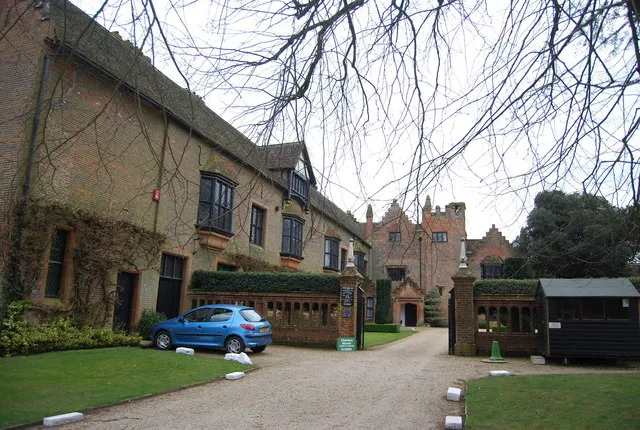
From Latimer, pick up the footpaths heading back towards Chenies. The route crosses fields and skirts copses before rejoining the lane above Chenies Bottom. This is the part where winter light does the heavy lifting. Low sun, bare trees, a few rooks, and the manor house appearing below you. Keep to the path, close gates, and give livestock plenty of room.
Back in Chenies, the village pub is the obvious end point. The Bedford Arms has long been the local landmark for a late lunch or a drink, but check 2026 winter serving times before you promise yourself a roast. If you are walking on a Sunday, book ahead or arrive early.
Practicalities and access
This is not a wheelchair or pushchair route. Stiles, mud, gradients and uneven field paths make it unsuitable for wheels, and the climb out of the valley is steep in places. Well-behaved dogs are welcome on the public paths, but leads are needed around livestock and near the roads.
Parking in Chenies is limited, so park considerately and do not block lanes, drives or the village green. The nearest railway stations are Chorleywood and Rickmansworth, with bus and taxi connections to the village; check 2026 timetables before relying on them. Carry water, a snack, a waterproof and a warm layer. The valley can be several degrees colder than the village.
A 2026 note on escaping the crowds
The easiest way to find stillness here is to avoid the obvious times. Go midweek if you can. Start early. Skip the weekend of a nearby Christmas fair. Winter walks are not about covering ground quickly; they are about noticing. A frost line along a fence, a heron lifting off the river, the smell of woodsmoke from a cottage chimney.
Chenies does not need to be sold as a hidden gem. It is simply a quiet corner that rewards the people who turn up when the crowds have gone home. Wrap up, take the lane slowly, and let the valley do the rest.